
Rescue Talk™

Fall Protection: Checking a Box or Protecting People?
We hear it said in just about every fall protection class we teach. We’ll ask about fall protection policies and someone raises a hand and says, “We always tie off at four feet.” It’s usually said with confidence, like it’s a settled issue without considering the effectiveness of the equipment on hand. People are trying to follow the rules and keep themselves and their coworkers safe – and that’s a good thing. The problem is that adequate consideration may not have been given to the fall protection equipment to be used and its effectiveness in a given scenario – i.e., a four-foot drop.

Where the “Four-Foot Rule” Comes From…
The OSHA standard for general industry is fairly straightforward on this topic. It tells us that fall protection is required when you are four feet or more above the next level, or at any height if you are working above dangerous equipment. That’s the trigger. It’s the point where you have to stop and do something about the hazard. However, it does not tell you is the answer is always a harness and a lanyard. That’s where the disconnect usually happens. Policies get written in a way that lean heavily on personal fall arrest systems, or workers interpret a general requirement as a very specific action, and before long “tie off at four feet” becomes the rule everyone repeats.
The issue shows up when you start looking at whether that approach would actually protect you or not. Most traditional fall arrest equipment, especially fixed-length lanyards, require more clearance than most workers realize (i.e., more than four feet to deploy, etc.). Manufacturers will often specify that you need well over 12 feet from your anchor point to the lower level for the system to deploy and safely stop a fall. So, if you’re working at four or five feet and you clip into a standard lanyard, you may technically be “tied off,” but if you go over the edge, there’s a good chance you’re still hitting the ground or the next level before the system does its job. At that point, the requirement has been followed, but the worker hasn’t actually been protected. That’s a tough truth for a lot of folks – especially when they’ve been told for years that tying off is the safe move.
“Manufacturers will often specify that you need well over 12 feet from your anchor point to the lower level for the system to deploy and safely stop a fall.“
There have been some advances in equipment, and it’s worth acknowledging that. Certain overhead self-retracting lifelines are designed for lower clearance applications and can stop a fall in a shorter distance. But even then, it’s not something you assume. You have to look at the specific product, read the manufacturer’s data, and understand exactly what kind of clearance it needs under real conditions. Deployment distance, deceleration, and safety factors all matter. Without that, you’re guessing. And in fall protection, guessing tends to show up at the worst possible time.
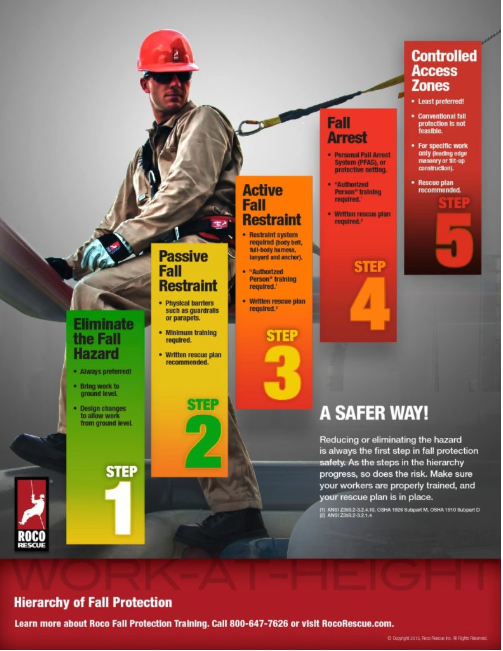
The Hierarchy of Fall Protection
This is why we spend so much time talking about the hierarchy of fall protection. It’s crucial to carefully evaluate the different levels and precautions and then choose the appropriate equipment for the task.
Elimination
Eliminate the task entirely! The first step is always to ask whether the work needs to happen at height in the first place. If you can eliminate it, or even reduce how often it’s done, you’re lessening exposure for personnel. The elimination step doesn’t always get the attention it deserves, but it’s the cleanest solution you have. Get creative in choosing a safer way to do the task.
“Even small reductions in how often someone is exposed to a fall hazard can make a meaningful difference over time. ”
Passive Protection (Guardrails)
If the work must be done, the next move is to build protection into the environment. Guardrails are a good example of passive protection. When they’re designed and installed correctly, they prevent the fall without requiring the worker to do anything at all. There’s no tying off, no adjustment, no decision-making in the moment. The tradeoff is that they take time and resources to install, which is why they tend to make the most sense for routine or repeated tasks. But when they’re in place, they remove a lot of the variables that cause problems.
Active Fall Restraint
After that, you get into active fall restraint. This is when you’re wearing protective equipment, but the goal is still to prevent the fall from happening. You set up a system so that you physically cannot fall. Adjustable lanyards are common here, and when they’re used correctly, they allow a worker to do the job without ever being able to step into a position where a fall is possible. It’s a different mindset than fall arrest. You’re not planning for the fall and catching it; you’re preventing the fall from ever happening.
Personal Fall Arrest Systems
Personal fall arrest systems come in at the end of that chain. They absolutely have their place, and there are plenty of situations where they’re necessary. But it’s important to recognize what they are. They don’t stop you from going over the edge. They allow you to fall and then try to stop you safely within the available space. That’s a much narrower margin for error, especially at lower heights. If the clearance isn’t there, or the system isn’t set up correctly, it doesn’t work the way people expect it to.
What to Do with “Tie Off at Four Feet”
So, when someone says, “We always tie off at four feet,” it’s worth slowing down a bit. It’s a good opportunity to take a closer look at what’s really being done to protect the worker. Not just whether a box is being checked, but whether the system in place would actually do its job if something went wrong. That’s usually where the conversation starts to shift, and where better solutions start to show up.
If you want to learn more about fall protection or dig into misconceptions like this in a practical way, we cover it in our Competent Person Fall Protection and Rescue from Fall Protection courses. The goal is to build a solid understanding of what the standard requires and how to apply it in a way that truly protects workers in the field.

Interested in Fall Protection Training?


