Compliance Tools
“We’re here to keep your team safe, your program strong, and your site ready for whatever challenges may come your way.”
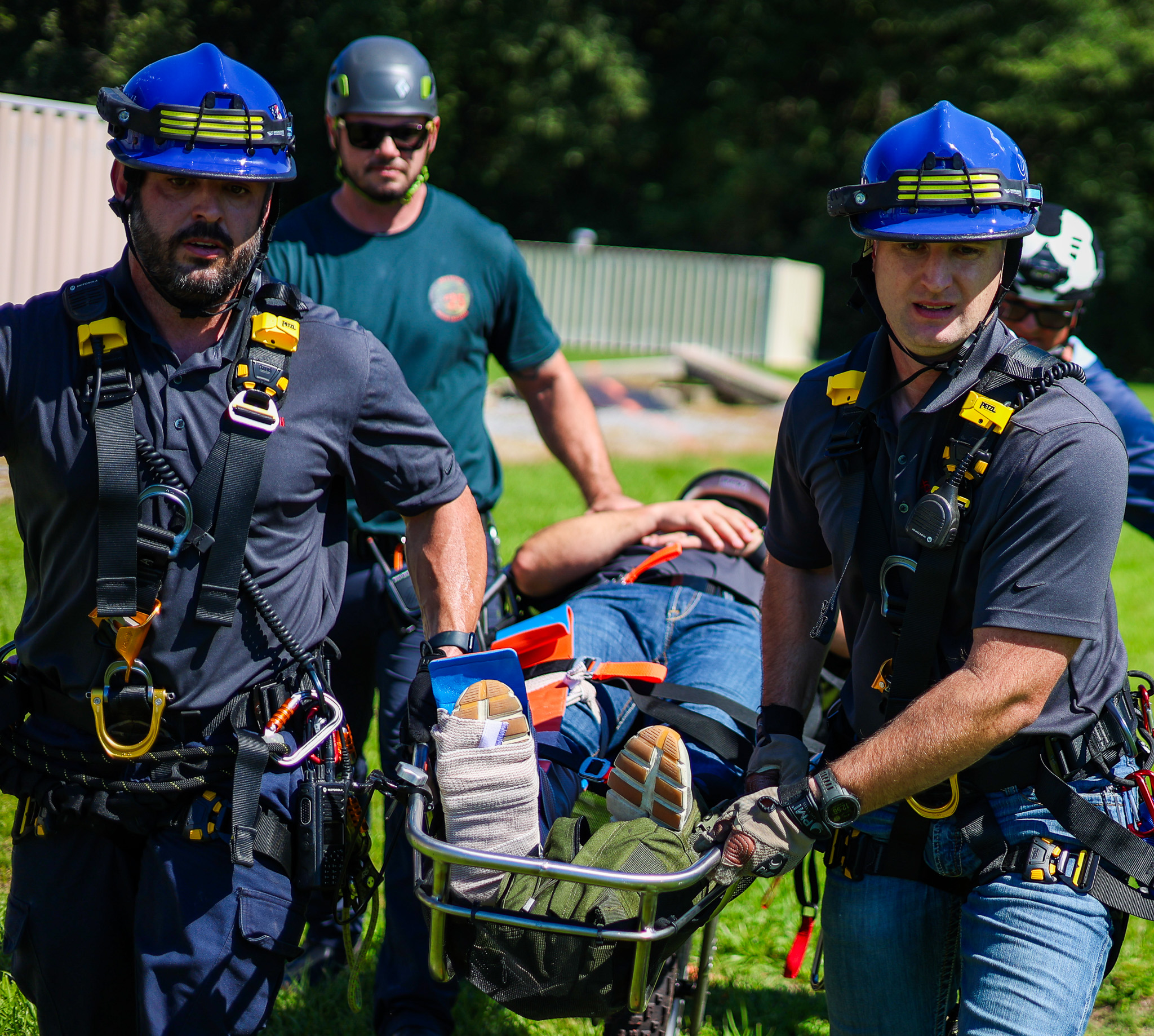
If you have employees working in or around confined spaces, you must provide safe and timely confined space rescue services (whether in-plant or contracted services). The rescue service must be trained, prepared, and equipped for the applicable confined space types you may have on site. Normally, this includes elevated rescue as well.
Here you will find numerous free resources like posters, checklists, and practical guides, which are designed to keep your people safe, your program strong, and your site ready for whatever rescue challenges may come your way. We have included reference material from OSHA and other national consensus standards such as NFPA and ANSI.
And remember, you can also Talk-to-a-Human at 800-647-7626. We look forward to hearing from you!
Explore This Page…
- Key Regulations for Rescuers
- Are ALL Your Confined Space Compliance Bases Covered?
- Can Your Rescue Service Walk-Their-Talk?
- Can I Rely on Local 9-1-1 Services?
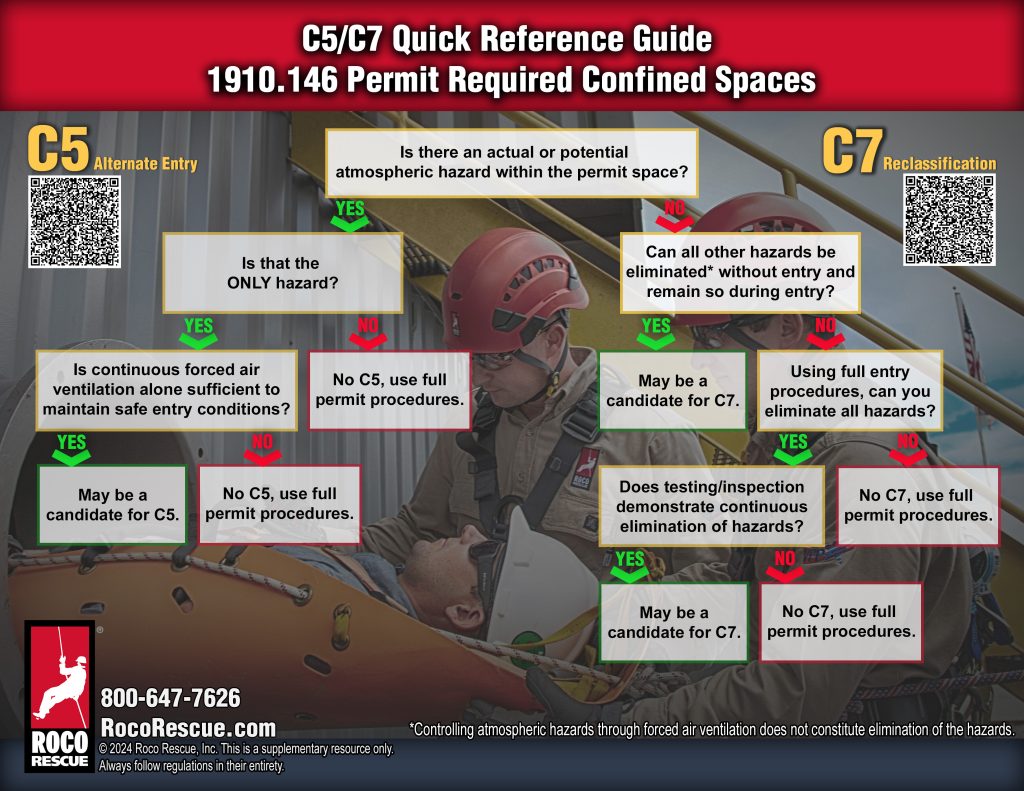
- Can’t I Simply Use 1910.146 (c)5 or (c)7 for Alternate Entry and/or Reclassification?
- What Are My Options For Documented Performance Evaluations?
- Do I Need To Be Concerned with National Consensus Standards?
- Safety Posters & More…
Key Regulations for Rescuers
While there are numerous applicable safety regulations for rescue operations, the need (and capability) for “confined space rescue” is critical for keeping your personnel and your workplace safe. Confined spaces are inherently dangerous and pose a myriad of hazards for workers and rescue teams alike. Since the early 1990’s, OSHA 1910.146 Permit-Required Confined Space (PRCS) regulation has played a key role in making confined space entry operations safer.
OSHA 1910.146 (Permit-Required Confined Spaces) addresses these hazards by requiring employers to “preplan” for successful rescue operations before entry work begins. It is a comprehensive regulation that is primarily “performance based,” in that OSHA wants to see the documentation that your rescue service is indeed capable.
OSHA Appendix F to Standard 1910.146 provides real-world criteria for employers to evaluate their rescue service. It helps to assess the timeliness and effectiveness of rescue response whether a service is adequately trained and equipped to perform confined space rescue and high angle, elevated rescues, if relevant for site operations. The performance evaluation documents “realistic practice rescues” to ensure readiness, timeliness, and rescue capabilities.
Appendix F can be used for testing or evaluating your rescue team or provider against OSHA’s Appendix F Performance Evaluations. Note: The use of “non-mandatory” in Appendix F can be confusing. It’s important to keep in mind that while the described method of team evaluation in Appendix F is considered non-mandatory; performing an evaluation of your rescue service is required.
OSHA 1910.134 (Respiratory Protection) Atmospheric hazards are a major cause of fatalities in confined spaces (up to 60% of fatalities are “would be” rescuers in multi-fatality incidents). The atmospheric conditions inside a confined space can change in seconds, going from an acceptable level to deadly. History has shown that when things go wrong inside a confined space, rescuers are often at equal or greater risk than the entrants they’re trying to rescue.
OSHA 1910.134 plays a critical role in safe confined space entry operations, especially when dealing with hazardous atmospheres (or potential hazardous atmospheres) that can be immediately dangerous to life or health (IDLH). Rescue must be planned in advance, immediate, and performed by individuals trained and equipped to survive the same hazards that brought the entrant down in the first place.
OSHA 1910.147 (Lock-out; Tag-out) This standard outlines precautions for servicing and maintenance of machines and equipment in which the unexpected energization or start up of the machines or equipment, or release of stored energy could cause injury to employees. This standard establishes minimum performance requirements for the control of such hazardous energy. Rescue personnel should be made aware of all necessary LOTO precautions taken. While rescuers are typically not directly responsible for LOTO, a general awareness with an added safety check can be a lifesaver when entering confined spaces.

Are ALL Your Confined Space Compliance Bases Covered?
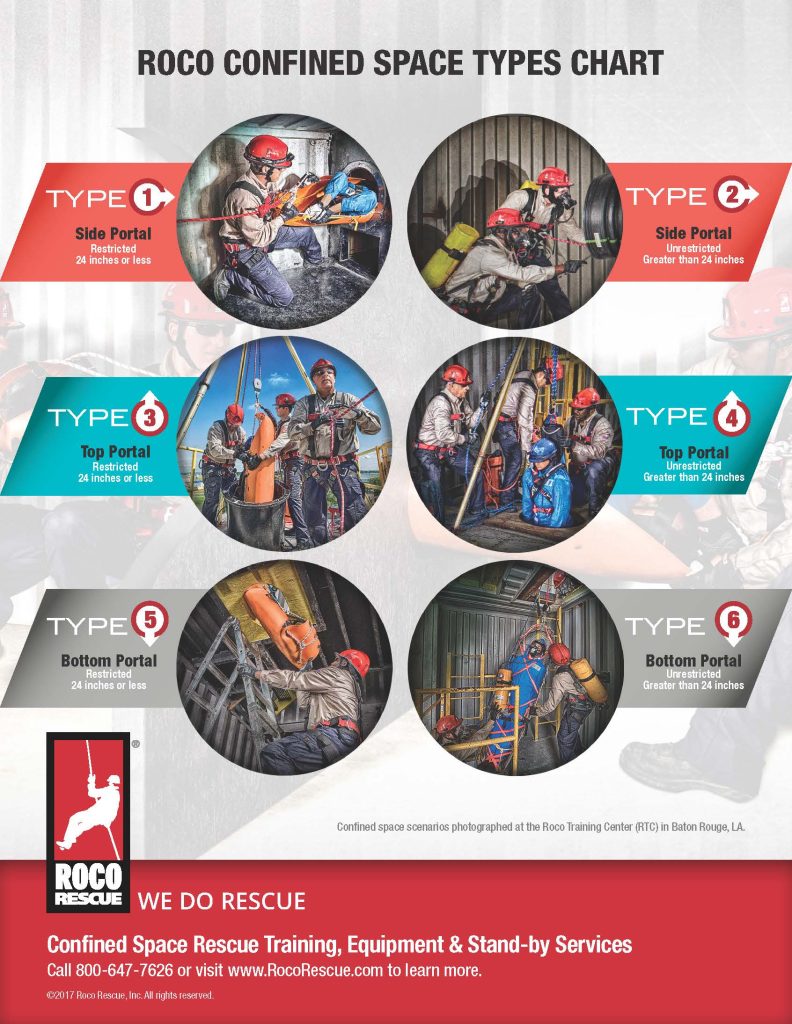
OSHA requires that rescue teams be evaluated in spaces that are representative of the actual hazards at your site, but the standard provides no practical tool to help identify those spaces. Roco created the Confined Space Types Chart to fill that gap and simplify planning. OSHA personnel have acknowledged that using a system like this can help employers show that their rescue capabilities match real-world conditions.
Roco’s Confined Space Types Chart & Compliance Guide is designed to assist you in complying with the rescue requirements of OSHA’s Permit Required Confined Space regulation (1910.146). It offers a “typing” system for categorizing confined spaces, which helps to prepare and plan for the specific types of confined spaces at your site.
There is no official OSHA “Confined Space Types” chart, but a widely used system developed by Roco Rescue categorizes permit-required confined spaces into six types (1-6) to aid in rescue planning and practice. These types are based on the portal opening size and location: Types 1, 3, and 5 have restricted openings (24 inches or less) and are considered “worst-case” scenarios.
Roco’s six confined space types…
- Type 1: Side entry, restricted portal (24 inches or less)
- Type 2: Side entry, unrestricted portal (greater than 24 inches)
- Type 3: Top entry, restricted portal (24 inches or less)
- Type 4: Top entry, unrestricted portal (greater than 24 inches)
- Type 5: Bottom entry, restricted portal (24 inches or less)
- Type 6: Bottom entry, unrestricted portal (greater than 24 inches)
How the chart is used…
- Rescue planning: The chart helps organizations determine appropriate rescue plans, equipment, and training based on the most restrictive portal size and location.
- Rescue team evaluation: It provides a framework for evaluating a rescue service’s capabilities against OSHA’s requirements, as described in OSHA 1910.146 Appendix F.
- Practice drills: Companies can use the chart to ensure their rescue teams practice in representative “worst-case” spaces that reflect the challenges of their own facilities.
Why the portal size is important…
- A portal 24 inches or less requires more specialized rescue techniques, equipment, and a higher level of expertise for patient packaging and movement.
- A portal greater than 24 inches can typically accommodate a packaged patient on a rigid litter and a rescuer using self-contained breathing apparatus (SCBA).
Can Your Rescue Service Walk-Their-Talk?
OSHA 1910.146 is all about “documented” performance capabilities – i.e., as a rescue service, can you “walk your talk?” OSHA is very clear about its requirements…a rescue team has to be capable of functioning in a safe and timely manner. Any deficiencies must be noted, corrected, and documented.
“The rescue team or service you choose must document their performance capabilities using realistic scenarios in the types of confined spaces from which rescue may be required.”
This applies whether you use an in-house rescue team, a contracted rescue service, or a local off-site response team. If an incident occurs and the rescue personnel you are depending on are not capable of safely performing a rescue, your company could be culpable.
One of the most common points of confusion we see is the difference between a rescue team that is available versus one that is truly on standby. These terms are often used interchangeably, but they represent very different levels of preparedness and response capability. For a deeper breakdown of what that means for your site, see our article on Rescue Standby vs. Available.

Can I Rely on Local “911” Services?
OSHA requires employers to document the rescue service’s ability to respond safely and in a timely manner. A written agreement is one of the most effective ways to demonstrate this verification.
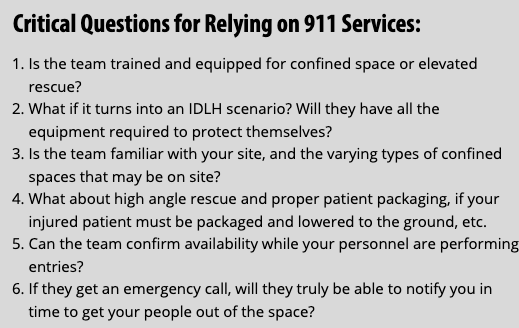
Local 911 services generally provide outstanding services to our communities, but are we expecting too much when we ask them to respond to a confined space or elevated rescue emergency where time, skill, and experience are critical?
If you have identified an off-site or local 911 team as your confined space resource, it is crucial that you thoroughly vet and document the team’s capabilities. A written agreement clarifying response is also highly recommended. Click here to view a Sample Agreement to Provide Rescue Response.
What about (c)5 or (c)7 for Alternate Entry and/or Reclassification of Spaces?
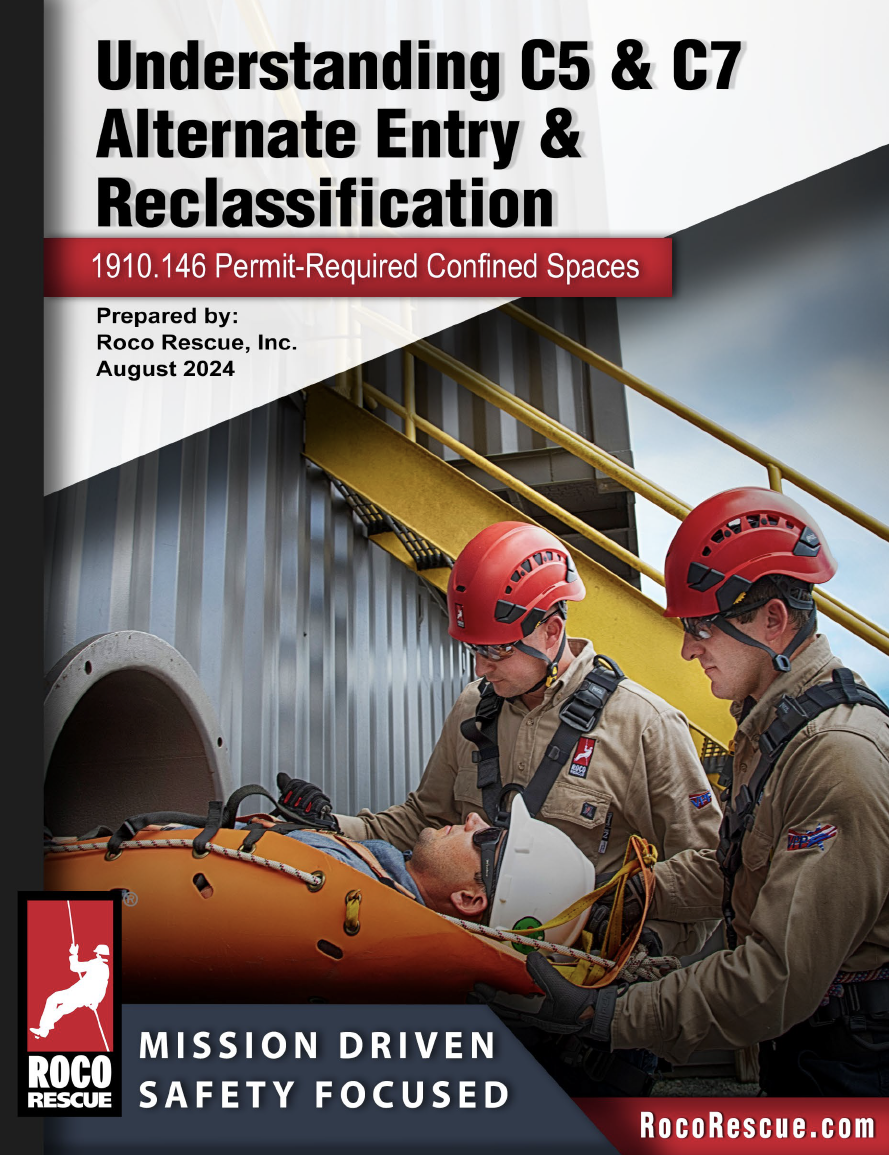
Our white paper, Understanding C5 & C7 Alternate Entry & Reclassification, provides a detailed analysis and offers clear, practical guidance on determining whether a confined space requires a permit or can be managed under alternate entry or reclassification procedures, simplifying compliance for anyone managing a permit-required confined space program.
This guide will improve your understanding of how to properly apply the (c)(5) and (c)(7) procedures, ensuring the highest safety standards at your site. You’ll gain insights into avoiding common pitfalls, such as the prohibited practice of combining C5 and C7, which can prevent costly mistakes and ensure adherence to OSHA regulations.
The paper also includes a C5/C7 Quick Reference Guide, designed to provide quick answers and streamline your decision-making process. This guide also explains the terms and requirements of C5 and C7 with straightforward language and real-world examples. It provides actionable steps to help you classify and manage confined spaces safely and efficiently. Equip yourself with the knowledge to make informed decisions about confined space safety.
What Are My Options For Documented Performance Evaluations?
Rescue performance evaluations can be conducted in-house using a documented testing and evaluation procedure, such as Appendix F from 1910.146. We find that many of our customers want an “objective” third-party evaluation with documented capabilities and/or deficiencies that can be corrected.
Roco Performance Testing
A Roco Team Performance Evaluation (TPE™) simulates the pressures of emergency response while providing third-party documentation of your team’s rescue capabilities. Graded scenarios are used to evaluate safe, timely and proficient response in confined space and elevated rescue environments. Each scenario is debriefed so that any deficiencies can be identified and corrected. Teams are scored on their rescue skills, response capabilities, and patient care. For documented individual team member performance evaluations (IPEs), refer to our Rescue Technician Certification programs based on NFPA 1006 Job Performance Requirements (JPRs).
Roco Rescue Challenge
Roco Rescue Team Challenge event also provides an excellent opportunity for your team to show its true capabilities. Each team will also receive a report documenting the practice drills and successful (or less than) performance in each of the challenging scenarios. Deficiencies in performance are clearly indicated to guide as to where improvements are needed.
Should I be Concerned with NFPA & ANSI?
NFPA 350 – Guide for Safe Confined Space Entry and Work
- NFPA 350 is a comprehensive document from the National Fire Protection Association (NFPA) that provides guidance for identifying, evaluating, and controlling hazards in confined spaces to ensure worker safety. It offers practical advice, best practices, and supplemental information to help organizations comply with regulations and standards, covering topics from hazard assessment and atmospheric monitoring to ventilation, hazard elimination, rescue planning, and management of change. For more information, check out our two part blog article on “What NFPA Says About Confined Spaces.”
ANSI Z117 – Confined Spaces Standard
- ANSI Z117 developed by the American Society of Safety Professionals (ASSP) that provides minimum safety requirements for entering, exiting, and working in confined spaces at ambient atmospheric pressure. The standard covers topics such as identifying and evaluating confined spaces (including permit-required and non-permit-required spaces), atmospheric testing, ventilation, personal protective equipment (PPE), training, and the responsibilities of the entry team. The primary purpose of ANSI Z117.1 is to protect workers from the hazards associated with confined spaces, which can include oxygen deficiency, toxic gases, or engulfment by loose materials. The standard helps ensure that workers can safely work in these hazardous environments.
Roco’s Involvement in Industry Standards
Roco Rescue is proud to contribute to the development of national consensus safety standards. Chris Carlsen serves on the NFPA 1006 Technical Committee for Rescue Technician Professional Qualifications, Chris McGlynn participates on the ANSI Z117 (Confined Spaces) and ANSI Z390 (Hydrogen Sulfide) committees, and Hunter Pinion serves on ANSI Z359.14 and Z359.4 related to fall protection and rescue systems. This involvement helps keep our team closely connected to current industry standards and best practices.

Safety Posters & Other Helpful Resources
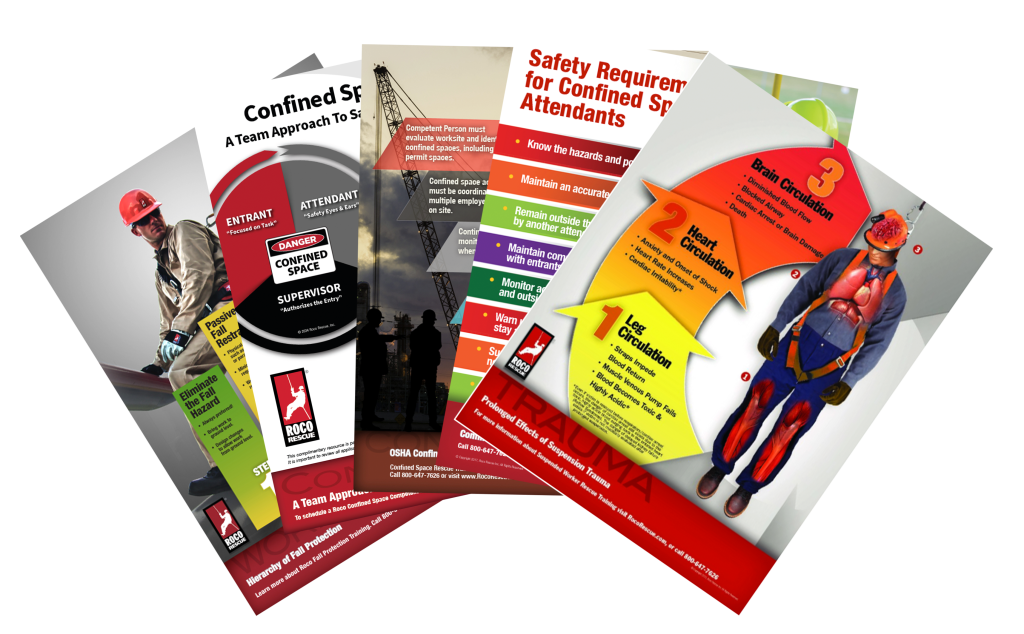
We are pleased to offer a variety of safety posters and checklists to make compliance simpler and more effective. From quick-reference guides to detailed checklists that walk you through OSHA requirements, these resources help crews stay on track and avoid the common pitfalls that lead to citations.
Popular downloads include:
- Confined Space Types Chart – The Roco Confined Space Types Chart is a quick way to identify your most restrictive spaces and plan rescue capabilities that match real-world conditions.
- Hierarchy of Fall Protection Poster – A visual reminder of the preferred order of controls, from elimination and substitution down to PPE. This poster reinforces decision-making during planning and job setup.
- Suspension Trauma Awareness Poster – A concise guide explaining the risks of orthostatic intolerance and key steps to prevent and respond to suspension trauma incidents. Perfect for use near work-at-height stations or rescue gear storage areas.
- Confined Space Entry Poster – A poster highlighting the roles and responsibilities of each party involved in the confined space entry team as paraphrased from 29 CFR 1910.146 Permit Required Confined Space Standard.
- Understanding C5 & C7 – Our C5/C7 White Paper breaks down alternate entry and reclassification in plain language, helping you decide when a space truly qualifies and how to apply the procedures correctly. It highlights common mistakes and gives practical guidance to keep your program compliant and safe.
Still Need Help?
Even with the right tools, confined space compliance can be tricky – but we’re just a phone call away. Connect with one of our experienced team members, and we’ll walk you through your questions or help build the right plan for your site. Remember, we’re here to help you keep your team safe, your program strong, and your site ready for whatever challenges may come your way.
Feel free to give us a call and Talk-to-a-Human at 800-647-7626.