Rescue Talk™
Real Rescue: In the Shadow of the Roco Training Center
It’s not often you get called for a rescue right next door, but this is literally what happened for firefighters assigned to Baton Rouge Fire Department Rescues #1 and #2. They were just finishing up a training session at FD Headquarters when a call came in for a medical emergency/rescue directly across the street. And it also happened to be directly behind the Roco Training Center.
While relatively simple, the rescue played out smoothly due to the readiness of the BRFD Rescue Companies and their proximity to the call. From a technical standpoint, it was a relatively simple rescue, but what made it worth sharing is how smoothly everything came together. The team was able to arrive on scene immediately and assess the situation. Additionally, the patient was quickly moved to definitive care. And, after all, isn’t that the goal of rescue work: (a) assess and stabilize the patient, and (b) get them to medical care as soon as possible.
This event occurred on February 24, 2026. The Baton Rouge Fire Department was dispatched to a medical emergency at a concrete plant on Harding Boulevard, directly behind the Roco Training Center. Engine 14 arrived to find a worker unconscious on an elevated platform with no ladder or fixed access. The employee had been lifted onto the platform earlier using a front-end loader bucket to grease operating equipment. Initial reports suggested the patient had suffered a seizure and was not recovering quickly.
According to bystanders, the patient had no known history of seizures, which can signal a potentially serious medical issue. Engine 14 placed a ground ladder to reach the platform and began patient care while requesting Rescue 1 to respond. At nearly the same moment, a technical rescue class for Louisiana Task Force 2 and Baton Rouge Fire Department personnel had just wrapped up across the street at BRFD headquarters. Several instructors were sitting down to review the day’s training when a rescue call alert popped up on their phones. Kanen Blackwell remembers looking at the map and doing a double take. “I saw the alert come through and noticed the location was the concrete plant right behind the training center,” he said.
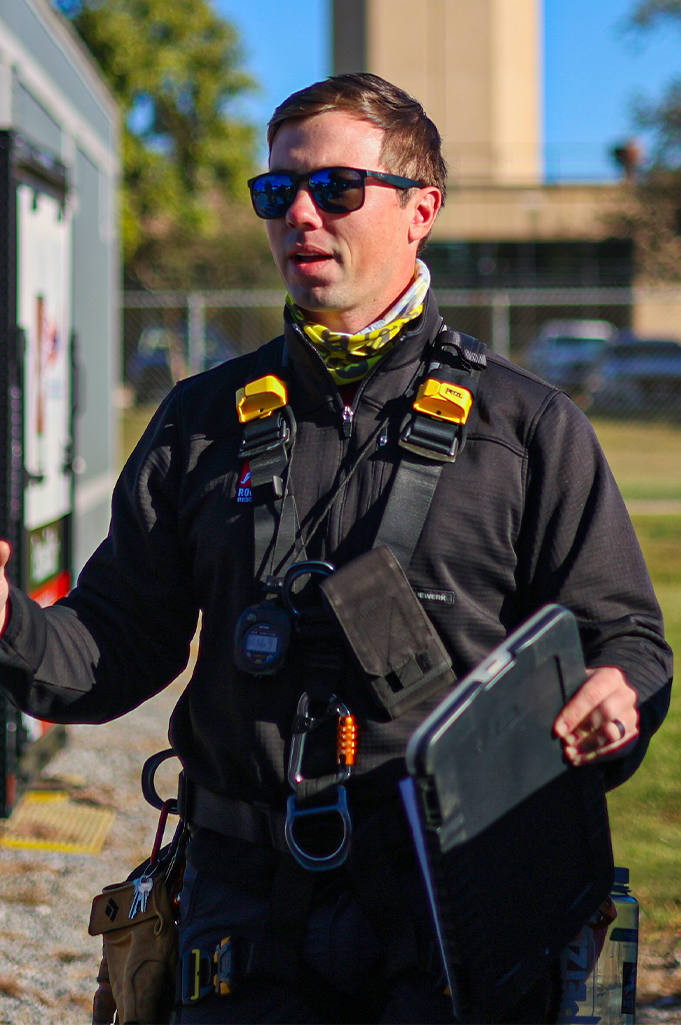
Blackwell looked at the guys and asked, “Y’all want to go do a rescue?”
By the time the instructor group arrived, Engine 14 had already established ground ladder access to the platform and EMS crews were evaluating the patient. The platform itself was the real challenge. The work area was very narrow, cluttered with steel supports and equipment, and sat roughly 15 feet above the ground. Firefighter Dreagen Bethel climbed to the platform to get eyes on the situation while the rescue truck was still en route with equipment. The patient was lying unresponsive on the platform. (Firefighter) Ryan Persick positioned the patient to support his airway while waiting for the rescue truck to arrive on scene. “The rescue itself was fairly straightforward,” Bethel said. “It was about a 15-foot lower. But the platform and work area were extremely tight.
“We had four rescuers, the patient, a paramedic, and the basket all trying to work in that space,” added Firefighter Bethel
There was a brief discussion about whether or not the patient could simply be lowered back down using the front-end loader that had lifted him up. But that idea didn’t last long. Relying on a civilian operator controlling heavy equipment along with the pressure of a serious medical emergency, introduces unnecessary risk. This is especially true when the patient is unconscious.
Instead, the team decided to use a low-point vertical lower using a Stokes basket. A horizontal litter system was considered but ruled out because there simply wasn’t enough room on the platform to manage the basket safely. The rescue team rigged a main-line using a CMC Clutch and a belay line with an anchored Petzl ASAP. Structural steel behind the rescuers provided solid anchor points, and a rail wrap was used to transition the basket safely over the platform guard rails. Firefighter Bethel operated the mainline, Rescue 1 Captain Nick Guidroz operated the belay line, and Firefighters Persick and Randy Price, transitioned the patient over the edge. While this was happening, Acadian Ambulance personnel continued patient care, stabilizing the patient and securing interventions for the big move.
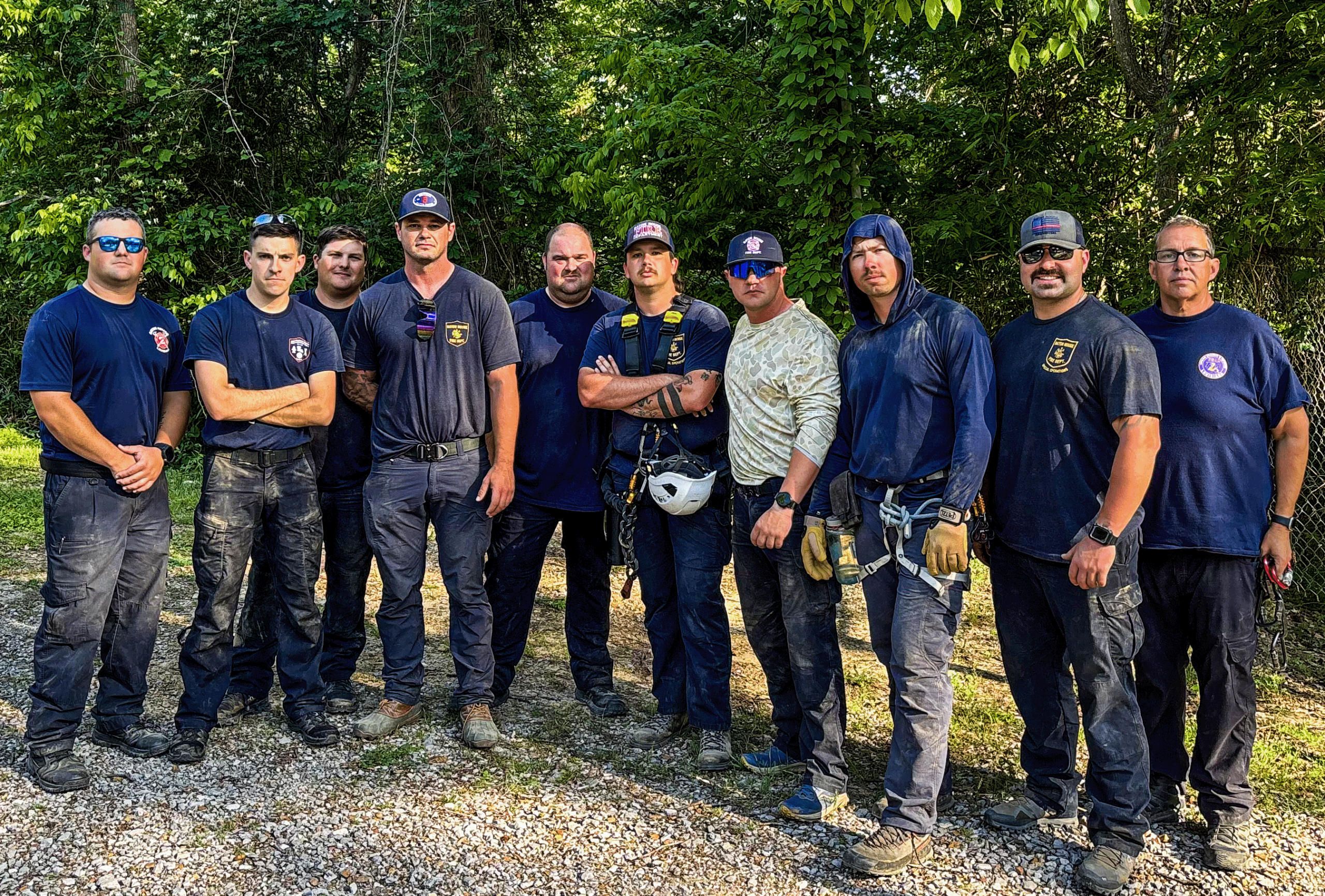
Once the patient was packaged, the team maneuvered the basket into position and executed the rail wrap to bring the litter over the edge. The vertical lower itself was short, and rescuers on the ground were able to go “hands on” and guide the basket safely to the ground. From the time the rescue unit arrived until the patient reached the ground, the operation took approximately 15 minutes. One detail that stood out about this rescue was the experience level on scene. Among the responders, there were three individuals who have served as Roco crew chiefs, two current Roco instructors, one current Roco CSRT Crew Member, and several others who had attended a Roco course in the past. When emergency responders share the same training background and operational language, communication tends to happen naturally and the work flows faster. Blackwell pointed to that shared training as being a major factor in how smoothly the rescue moved.
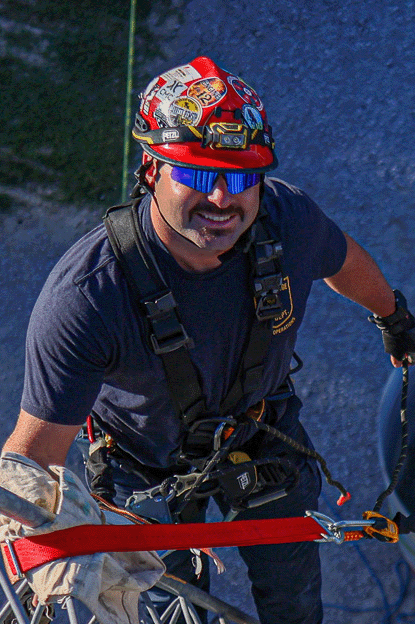
“You don’t rise to the occasion in moments like that,” Blackwell said. “You fall back on your training. When things get hectic, training is what keeps everything moving.”
Bethel saw the same thing from his position on the platform. “Everything flowed really well,” he said. “Even small potential issues were caught immediately because we had experienced people watching each other and communicating.” Technical rescues don’t always look dramatic. In this case the height was modest, and the rope system itself was fairly simple. What mattered was how quickly the team assessed the hazards, chose the safest option, built the system, and worked alongside EMS to move the patient. Within minutes, the patient was off the platform and in the hands of EMS for transport.
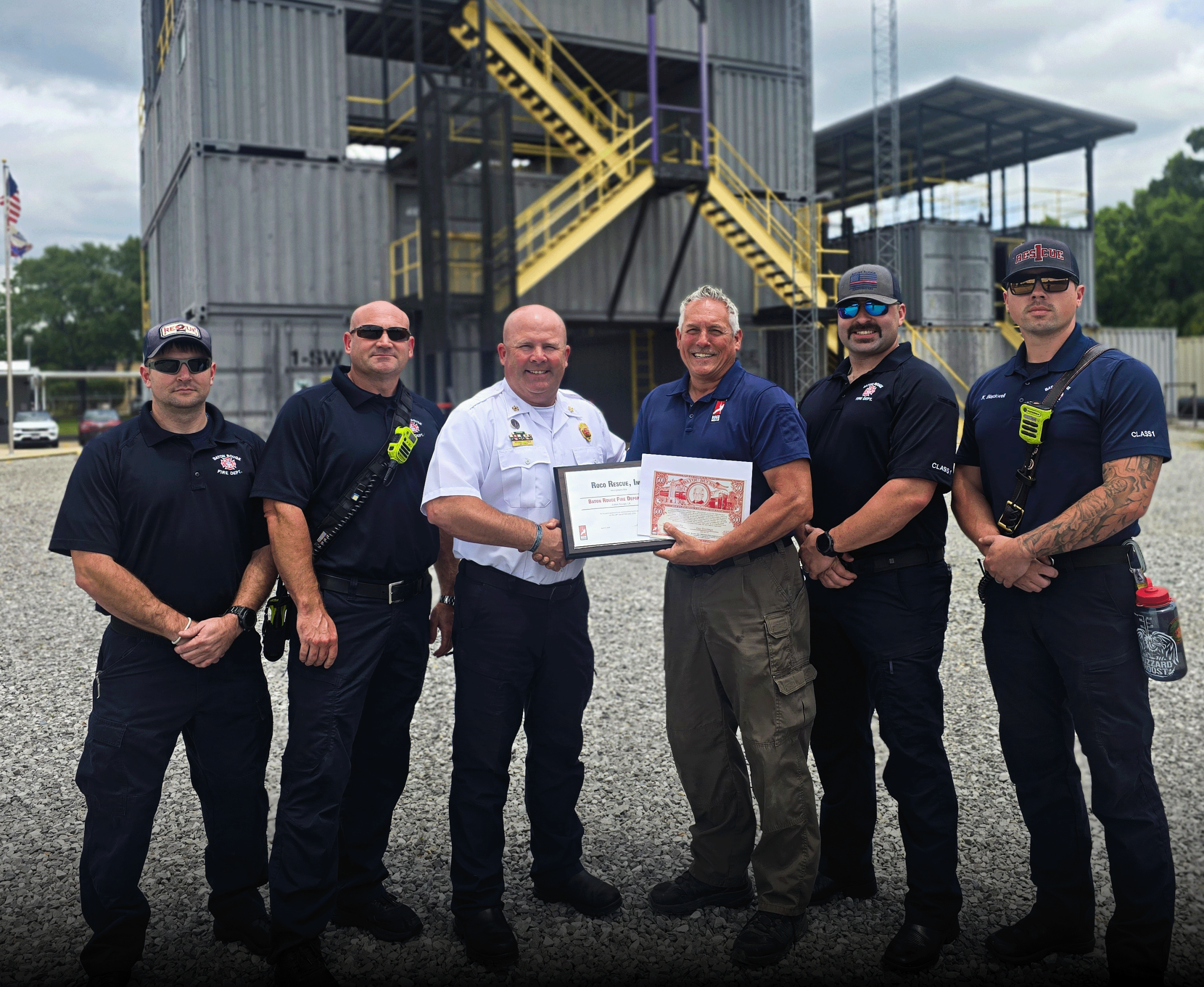
We are grateful to the Baton Rouge Fire Department for allowing us to share this incident. Roco Rescue has worked alongside BRFD for decades, and it’s always good to see shared training show up and make a difference during a real emergency. When agencies train together and speak the same operational language, the result is usually the same thing we saw here – a safe, timely rescue where the patient is quickly moved toward the care they need.
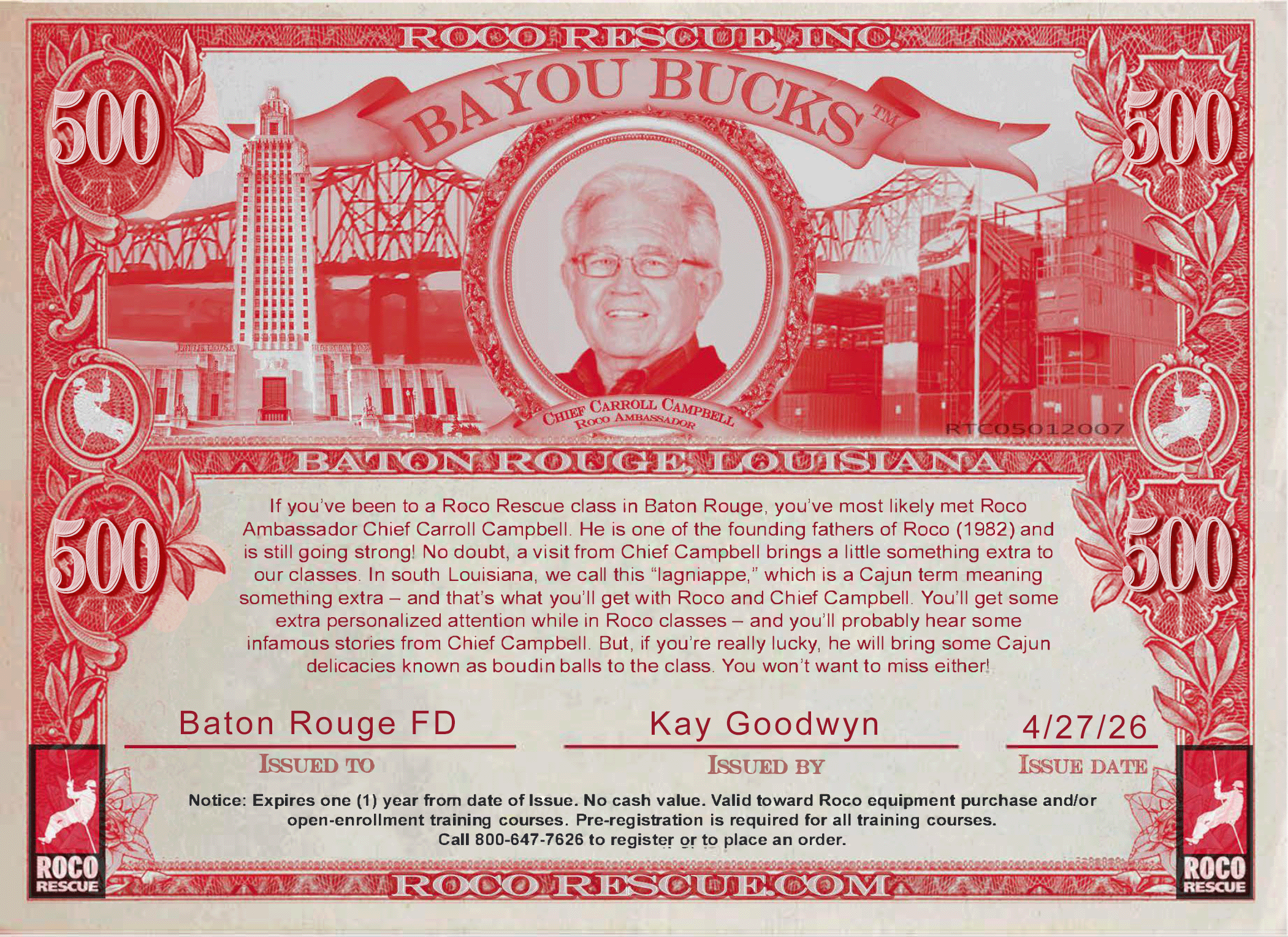
For this rescue, we’d like to recognize the Baton Rouge Fire Department with our “Real Rescue Plaque” and $500 in Roco Bayou Bucks to use towards training or equipment from the Roco Gear Shop.
Congrats, BRFD!
Does your department or facility have a real rescue to share? Contact us at info@rocorescue.com, or give us a call at 800.647.7626. Tell us your story and become eligible to win $500 in Bayou Bucks (Roco Store Credit) and a plaque to commemorate your efforts.